Decoding minibus capacity: Why seat count alone misleads renters
The 9-seater label comes from manufacturer homologation rules that count total seats, driver included. What the official Category B licence regulations specify on Service-Public.fr confirms this: any vehicle up to nine seats including the driver remains a standard car classification, requiring no special endorsement beyond your regular licence. The official circular from the Ministry of National Education recalls that the regulatory line is drawn at ten seats, where vehicles shift into transport-en-commun rules requiring different licences. Everything at nine seats or below operates as a standard passenger car legally.
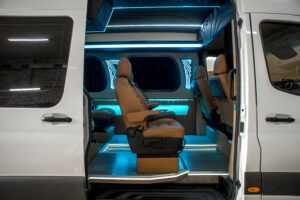
Here’s the thing: even the accurate passenger count doesn’t tell you what matters. Seat configuration determines usable space more than seat quantity. Third-row seats in models like the Ford Transit Custom or Renault Trafic fold flat when not needed, transforming an 8-passenger setup into a 6-passenger van with double the boot volume. Fixed-seat configurations in premium models like the Mercedes Classe V prioritize comfort over cargo flexibility—you get refined interiors and ample legroom, but those rear seats stay put whether you’re carrying two people or eight.
Transmission type intersects with capacity in ways rental sites bury in fine print. Automatic gearboxes, overwhelmingly preferred by international visitors unfamiliar with Paris traffic patterns, sometimes limit your model choices within a given capacity tier. A manual Ford Transit might offer modular seating; the automatic version could have fixed rows. This isn’t a flaw—it’s a design trade-off—but it means « 8-seater automatic » narrows your options compared to « 8-seater any transmission. »
Reality check: your luggage doesn’t care about legal categories—it cares whether the boot swallows four large cases or forces you to pile coats on the back row.
Your capacity selection roadmap in four checkpoints
- Count passengers excluding driver (9-seater = 8 passenger seats)
- Measure or list your largest luggage items (strollers = 2-3 suitcase equivalents)
- Match usage context (business equipment needs vs leisure travel flexibility)
- Verify parking dimensions at Paris destination if choosing full-size model
Capacity tiers explained: Matching your group profile to the right vehicle size
Matching capacity isn’t about maximizing seats—it’s balancing passenger count against luggage volume and Paris constraints. A 5.3-metre Transit carrying four passengers burns more fuel and limits parking options compared to a 4.9-metre Vito handling the same load.
Professional groups transporting bulky equipment face the inverse problem: underestimating cargo needs. Airport arrival logistics compound this challenge—navigating metro turnstiles with presentation cases, lighting rigs or photo equipment creates immediate friction before the Paris trip even begins. For crews arriving with such materials, minibus hire at Paris-Charles de Gaulle eliminates these hassles entirely, letting your team verify everything fits at pickup and start the trip without wrestling cases through Châtelet corridors.
- If 4-6 passengers with light luggage:
Mercedes Vito 8-seat delivers compact parking agility, sufficient boot space, and excellent fuel efficiency.
- If 4-6 passengers with heavy equipment:
Ford Transit with third row folded provides maximum boot volume while retaining 6-seat passenger capacity.
- If 7-8 passengers prioritizing comfort:
Mercedes Vito Luxe or Classe V offers enhanced interiors with moderate luggage capacity and fixed seating.
- If 7-8 passengers needing flexibility:
Renault Trafic or Toyota Proace provides folding seats enabling luggage expansion for mixed-use trips.
Compact flexibility: 6-7 passenger configurations for agile city navigation
The Mercedes Vito 8-seat (7 actual passengers) suits smaller groups prioritizing Paris maneuverability. At 4.9 metres, it fits residential parking spots that reject longer Transits. Boot volume with all seats up: three to four large cases plus soft bags. Fold the third row and you’ve doubled capacity—six large cases fit comfortably for families of four wanting luggage breathing room without piloting a commercial-feeling vehicle through Paris traffic.
Full capacity: 8-passenger setups balancing comfort and luggage volume
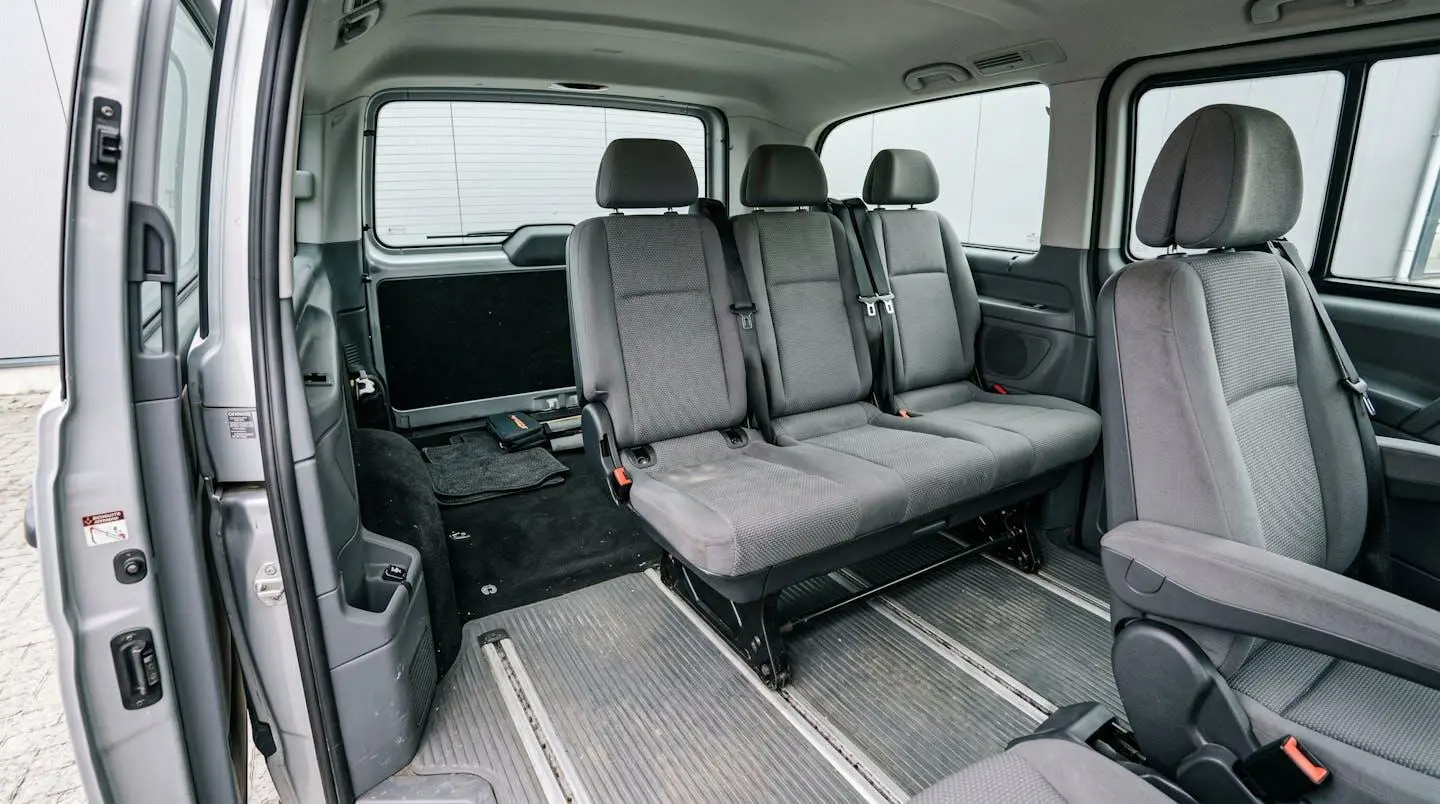
Ford Transit Custom, Renault Trafic, and Toyota Proace sit in the 9-seat category (8 passengers + driver), offering modular seating that makes or breaks mixed-use trips. At 5.2-5.3 metres, they push Paris parking limits but deliver flexible cargo solutions. All rows up: four to five large cases. Third row folded: substantial hauling capacity for equipment or shopping returns.
What rental agents rarely mention upfront: folding flexibility varies by model year. Some Transits feature split third rows (fold one side, keep the other); others fold as a single bench. Request specific seat configuration details if your passenger count fluctuates day to day.
Premium comfort: When luxury features reduce effective passenger count
Mercedes Vito Luxe and Classe V swap cargo versatility for interior refinement. Fixed seating means no fold-flat tricks. Boot space: three large cases reliably, four if you’re strategic. For eight passengers this feels cramped; for five or six prioritizing legroom it feels spot-on. These models suit business groups where presentation matters—corporate shuttles, client transport—choosing passenger experience over cargo flexibility.
| Model | Passenger Seats | Boot Estimate | Length | Transmission | Seat Type |
|---|---|---|---|---|---|
| Mercedes Vito | 7-8 | ~4 large cases | 4.9m | Auto | Fixed |
| Ford Transit Custom | 8 | ~6 cases (folded) | 5.3m | Manual/Auto | Folding |
| Renault Trafic | 8 | ~5 cases | 5.2m | Manual/Auto | Modular |
| Mercedes Classe V | 7 | ~3 cases | 5.1m | Auto | Fixed luxury |
Real-world capacity testing: Luggage scenarios that expose vehicle limits
Abstract trunk volume specifications fall apart when confronted with actual trip profiles. Consider a family of six heading to Disneyland Paris for four days: two adults, one teenager, three children under ten. Luggage sounds straightforward—six people, six cases, right? Now add the collapsible stroller (consumes space equivalent to two large cases), the car seat, winter coats purchased during an unexpected cold snap, and shopping bags accumulated across four park days. That theoretical « six large cases » boot capacity suddenly looks optimistic.
Professional groups face different physics. A corporate event crew transporting presentation materials for a trade show at Paris Expo Porte de Versailles: four passengers, but equipment includes two rolling display cases, a projector case, sample product boxes, and personal luggage. The math that worked for tourists (8 passengers = 8 cases) breaks down entirely. Equipment cases rarely stack efficiently—rigid corners and non-standard dimensions waste boot volume that soft suitcases would optimize.
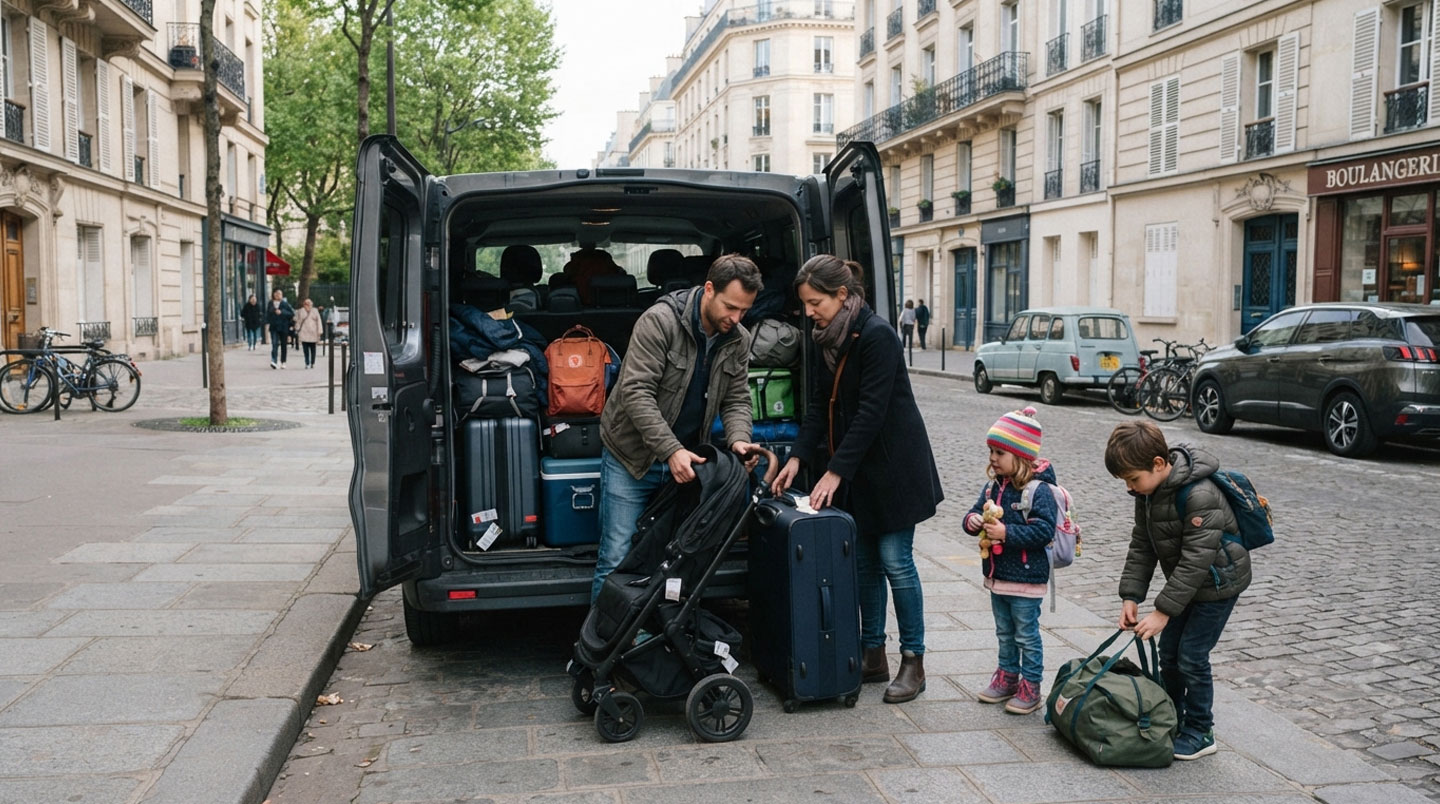
Return trip capacity catches groups off guard. Outbound from CDG, luggage packing is optimized—everyone packed strategically at home. Returning to CDG after a week in Paris? You’ve added wine bottles from a Loire Valley day trip, clothing purchases from Galeries Lafayette, toys and souvenirs from Disneyland, possibly cheese from Rue Cler markets. Industry feedback consistently shows groups underestimate this expansion factor, turning a comfortably-packed outbound trip into a boot-space Tetris challenge on return.
This capacity optimization mindset reflects emerging transportation trends where right-sizing vehicle choice replaces the default « biggest available » approach. A precisely-matched 7-seater serving your actual group of five uses less fuel and occupies less Paris street parking than an oversized 9-seater « just in case, » reducing resource waste while improving your navigation experience through Marais or Latin Quarter narrow streets.
Booking your optimal capacity: CDG delivery advantages and final checklist
The CDG airport delivery service lets you verify fit at pickup before committing to Paris traffic. Miscalculated? Adjustments happen at the airport parking point, not mid-trip. The 40 € discount using code PLUS26 for rentals of three days or longer (valid until 31 July 2026) provides budget cushion for right-sizing without overpaying for unnecessary capacity.
Accurate capacity matching cuts environmental impact too—a properly-sized 8-seater typically reduces fuel consumption compared to an oversized model driven half-empty across Paris, with industry estimates suggesting efficiency gains in the 15-20% range depending on load and route.

- Count passengers excluding driver (9-seater = 8 passengers + 1 driver)
- Measure largest luggage item and verify boot dimensions accommodate it
- Add 2-3 suitcase equivalents per stroller or bulky equipment to luggage count
- Verify accommodation parking permits vehicles over 5m if choosing full-size models
- Confirm automatic transmission availability during peak summer booking periods
Match your verified passenger count and luggage profile to the tier frameworks above, book with confidence knowing CDG pickup validates everything before you navigate Paris streets, and apply PLUS26 at checkout for €40 savings on rentals through end-July 2026.