Important information
This content is provided for informational purposes and does not constitute medical advice. Consult a qualified orthopaedic surgeon for any decision regarding your knee injury treatment.
The surgery decision in 30 seconds:
- Complete ACL tears in athletes wanting to return to pivoting sports usually require reconstruction
- Mechanical symptoms like true locking warrant surgical assessment regardless of MRI findings
- At least 3 months of structured physiotherapy should precede most surgical decisions
- Returning to sport before 9 months post-surgery carries 7 times higher re-injury risk
The truth is, the right path depends on factors that are unique to you — your age, activity level, the stability of your knee, and the extent of the injury. What works for your teammate may not be what your body needs. Getting a precise, specialist assessment early is not overreacting — it’s the smartest move you can make for your long-term recovery.
What this guide covers
Not every knee injury needs surgery – but some absolutely do
I recently worked on patient education materials for a case that stuck with me. Thomas, 28, amateur footballer, twisted his knee during a Sunday league match. His GP said rest and ice. His physio suggested strengthening exercises. Six months later, his knee still gave way on uneven ground. By the time he saw an orthopaedic specialist, he had developed a secondary meniscus tear that complicated his eventual surgery.
This pattern appears frequently in clinical practice. Athletes wait too long, hoping the problem will resolve. Or they rush into surgery when structured rehabilitation would have worked. Both mistakes carry consequences.
The decision framework matters more than gut feeling. Complete ACL tears have limited natural healing capacity, particularly if you intend to return to sports involving cutting, pivoting, or sudden direction changes. Partial ligament injuries in recreational athletes often respond well to physiotherapy alone. The challenge lies in determining which category your injury falls into.
17%
of athletes return to pre-injury performance level after ACL reconstruction
That statistic from a 2024 nationwide return to sport study surprises most patients. While 62% return to participation at some level, only 17% reach their previous performance standard. Surgery isn’t a magic reset button. It’s a tool that works brilliantly when indicated—and creates unnecessary risk when it isn’t.
The 4 signs that point toward surgery
In consultations I’ve observed at major surgical centres, the decision criteria tend to follow predictable patterns. Four factors consistently push the recommendation toward surgical intervention. Missing even one of these doesn’t automatically rule out surgery, but their presence together creates a strong case.
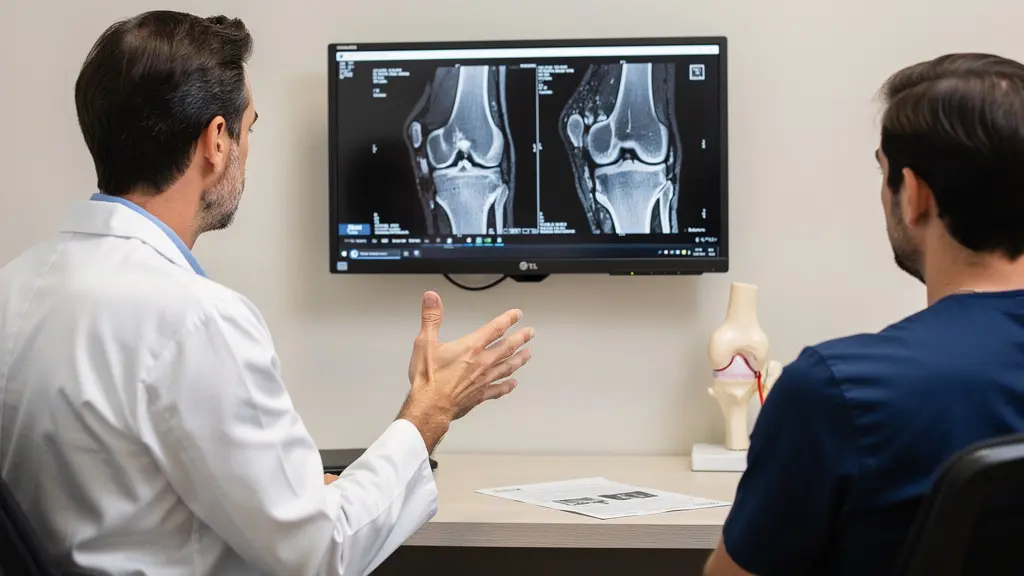
If you’re weighing options for knee surgery after a sports injury, these are the questions your specialist will be asking.
- Complete ACL tear + return to pivoting sport planned:
Strong surgical indication. Conservative management rarely allows safe return to football, rugby, basketball, or skiing at competitive intensity.
- Partial ligament injury + stable knee during daily activities:
Conservative treatment first. Three to four months of structured physiotherapy often succeeds.
- Mechanical symptoms (true locking or catching):
Surgical assessment recommended. These symptoms suggest loose bodies or meniscus pathology that physio cannot address.
- Failed 3+ months of physiotherapy:
Surgery consultation warranted. An adequate conservative trial has been attempted.
Complete ligament tears in active individuals
The ACL doesn’t heal on its own. That’s the blunt reality. Unlike bone, which knits back together, a completely ruptured ACL remains ruptured. For sedentary individuals or those happy to modify their activities, this might be acceptable. The knee can function reasonably well for daily tasks without an intact ACL.
But athletes wanting to return to pivoting sports face a different calculation. Each time your knee gives way during cutting movements, you risk damaging the meniscus or articular cartilage. These secondary injuries often prove more consequential for long-term joint health than the original ligament tear.
I’ve seen this progression repeatedly in clinical documentation. Delay reconstruction by a year or more in an active individual, and the surgical procedure often becomes more complex. What might have been straightforward ligament reconstruction becomes ligament reconstruction plus meniscus repair or partial removal.
Mechanical symptoms that won’t resolve
True mechanical symptoms demand attention. I’m not talking about stiffness or the vague sensation that something isn’t right. The specific symptoms that point toward surgical pathology include:
- True locking—the knee physically cannot extend fully, then suddenly releases
- Catching—a distinct snag or click with specific movements
- Giving way—the knee buckles without warning during pivoting or descending stairs
These symptoms typically indicate something is mechanically obstructing normal joint function. A loose fragment of cartilage. A bucket-handle meniscus tear. A displaced piece of bone. Physiotherapy cannot remove a mechanical obstruction. It can only work around it—often inadequately.
When waiting creates bigger problems: Prolonged ACL deficiency in active individuals is associated with increased risk of secondary meniscus injury, according to published research. If your knee continues giving way despite activity modification, the case for surgery strengthens with each episode.
Failed conservative treatment after adequate trial
What counts as an adequate trial? According to NHS guidance on ACL treatment options, 3-4 months of structured physiotherapy is reasonable before concluding that conservative management has failed. The Lancet’s ACL SNNAP trial used a similar threshold—at least 3 months of rehabilitation before considering the non-surgical approach unsuccessful.
The key word is structured. Occasional exercises at home don’t constitute a proper trial. You need progressive loading, supervised progression through rehabilitation milestones, and objective measurement of strength and stability. If you’ve genuinely committed to physiotherapy for three months and your knee remains functionally unstable, that’s meaningful information. Your body has told you something.
But I’ve also seen patients declare conservative treatment a failure after six weeks of half-hearted effort. That isn’t a fair test. Before pursuing surgery, ensure you’ve given physiotherapy a genuine opportunity to work.
When conservative treatment is the smarter choice
Surgery carries risks. Small ones, statistically—according to research on NHS complication rates following ACL reconstruction, the 90-day deep vein thrombosis rate sits around 0.30%—but real nonetheless. Beyond immediate complications, there’s the rehabilitation commitment. The time off work. The months before you can run again, let alone play sport.
For many knee injuries, this investment isn’t necessary. Not all patients experience recurrent instability after ACL rupture. Some remain symptom-free with lifestyle modifications, avoiding the specific movements that stress the ligament.
When surgery makes sense
- Complete ACL tear with high athletic demands
- Mechanical symptoms preventing normal function
- Young athlete with long sporting career ahead
- Combined injuries requiring simultaneous repair
When physio is worth pursuing first
- Partial tears with good functional stability
- Recreational athletes willing to modify activities
- No mechanical symptoms or giving way episodes
- Isolated injury without meniscus involvement
The honest conversation many patients avoid: are you genuinely going to return to high-level pivoting sport? If you’re 45 and your primary activities are cycling and gym work, an intact ACL may not be essential. Your activity profile matters as much as the MRI findings.
Athletes exploring rehabilitation options might benefit from understanding strategies for mastering long-distance runs, as running forms the foundation of many return-to-sport programmes. The transition from non-impact to impact activities follows predictable progressions that physiotherapy protocols address systematically.
Surgical decisions should be based on activity level and goals rather than chronological age alone. I’ve seen 55-year-olds with higher athletic demands than some 25-year-olds. The question isn’t how old you are—it’s how you want to live.
From injury to decision: realistic timelines
The gap between injury and surgery isn’t wasted time. It’s assessment time. Rehabilitation time. Decision time. Rushing creates problems. So does waiting indefinitely.
-
Initial injury, swelling management, GP assessment -
MRI scan, specialist consultation, diagnosis confirmed -
Structured physiotherapy trial (minimum 3 months) -
Decision point: surgery or continued conservative management -
Surgical intervention and rehabilitation to return-to-sport criteria
The timing of return to sport study published in the Journal of Orthopaedic & Sports Physical Therapy established a critical threshold. Athletes returning to pivoting sports before 9 months post-reconstruction have 7 times higher re-injury rate. Each month of delay up to 9 months reduces risk by around 50%.
After 9 months, the risk reduction plateaus. So the magic window sits somewhere between 9 and 12 months for most athletes. Rushing back at 6 months because you feel ready is one of the most expensive mistakes in sports rehabilitation.
Criteria-based progressions matter more than calendar dates. Recent quality improvement data shows that centres implementing objective return-to-sport criteria saw return times increase from 6 to nearly 10 months—aligning with evidence for safer outcomes. This might seem counterintuitive. Slower is better? In this case, yes.
Maintaining fitness during recovery requires thoughtful adaptation. Understanding equipment for achieving your fitness goals helps athletes stay conditioned through the non-weight-bearing phases of rehabilitation, using upper body work and pool-based exercise to maintain cardiovascular fitness without stressing the healing knee.
Your questions about knee surgery decisions
Can I avoid surgery if I stop playing sport entirely?
Possibly. Some people with ACL-deficient knees function well for daily activities without surgery. The risk is that even minor pivoting moments—stepping off a kerb awkwardly, turning quickly in the kitchen—can cause giving way episodes that damage other structures. If you’re genuinely willing to accept lifestyle limitations and your knee is stable for daily tasks, conservative management may succeed. But be honest with yourself about your actual activity patterns.
Does my age affect whether I should have surgery?
Less than you might think. Surgical decisions are based on activity level and goals rather than chronological age alone. A fit 50-year-old who skis regularly and plays tennis twice weekly may be a stronger surgical candidate than a sedentary 30-year-old. The question is what you want your knee to do, not how old you are. That said, healing capacity and rehabilitation tolerance do change with age—discuss realistic expectations with your surgeon.
What happens if I choose conservative treatment and it fails?
You can still have surgery. Delayed reconstruction is common and generally successful, though outcomes may be slightly less predictable than acute reconstruction in some studies. The concern with prolonged delay is secondary meniscus damage from recurrent instability episodes. If conservative treatment fails within 3-4 months and your knee continues giving way, proceeding to surgery before significant secondary damage develops is reasonable.
How do I know if my surgeon is experienced enough?
Research suggests that surgeon and centre experience influences outcomes. Reasonable questions include: How many ACL reconstructions do you perform annually? What is your complication rate? What graft type do you typically use and why? A high-volume surgeon performing 50+ reconstructions per year will generally have more refined technique than someone doing 5 per year. In the UK, NHS data on individual consultant outcomes is increasingly available—ask about it.
Will my knee ever be the same after surgery?
Honestly? Probably not exactly the same—but potentially very close to normal function. Most athletes report good or excellent outcomes. The 2024 nationwide data shows 62% return to participation and 50% return to sport at some level. However, only 17% return to their exact pre-injury performance standard. For recreational athletes, the difference may be imperceptible. For elite competitors, subtle changes in confidence or proprioception sometimes persist.
The next step for your knee
Whatever your situation — whether you’re an elite athlete or a weekend player — the next step for your knee starts with a clear diagnosis, not a guess.
Your immediate action plan
- Get a proper diagnosis: MRI and specialist consultation if not already done
- Commit to structured physiotherapy for at least 12 weeks before deciding on surgery
- Track giving way episodes—their frequency guides the surgical conversation
- Be honest about your activity goals when discussing options with your surgeon
The right decision isn’t the same for everyone. What matters is making an informed choice based on your specific injury, your activity demands, and realistic expectations about outcomes. That requires good diagnostic information, an adequate trial of conservative treatment where appropriate, and a candid conversation with a specialist who understands athletic demands.
Important considerations before any surgical decision: This guide provides general information and cannot replace a personalised assessment by an orthopaedic surgeon. Treatment recommendations vary based on individual anatomy, injury severity, and activity goals. Recovery timelines mentioned are averages—individual outcomes may differ significantly. Consult an orthopaedic surgeon specialising in sports traumatology for advice specific to your situation.